
Ask a formulator about hexylene glycol properties and you will likely receive a variety of answers. One formulator may refer to it as a coalescent; another may say it is a coupling agent; another may use it in cleaning products without knowing exactly why it works. All three are somewhat correct, and this is what causes hexylene glycol to be misunderstood. Let’s begin by discussing the properties of hexylene glycol that result in these functions, discuss the various types of hexylene glycol available, and provide an honest assessment of where hexylene glycol belongs.
Table of Contents
Properties of hexylene glycol: what it actually is
Hexylene glycol is the common name given to 2-methyl-2,4-pentanediol (CAS # 107-41-5). Pay close attention to the term “diol” in this chemical name. The molecule possesses two hydroxyl groups and no ether linkages.
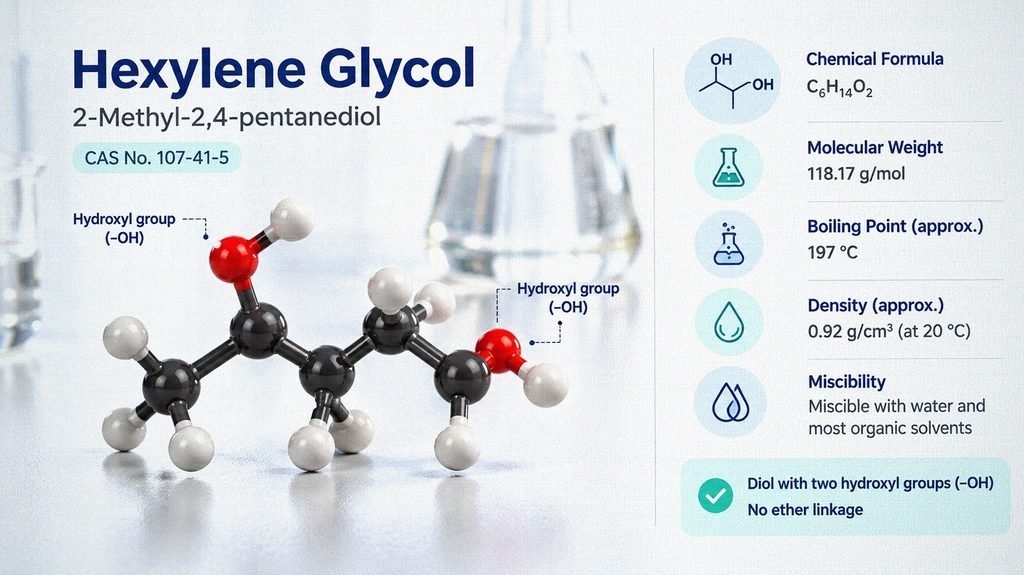
Note: This illustration is intended for general informational purposes. Chemical properties are approximate and should be verified against authoritative technical references and the applicable product documentation.
Thus, hexylene glycol is not a glycol ether even though many price lists list hexylene glycol adjacent to glycol ethers. Buyers frequently overlook this fact; however, it has implications. Glycol ethers have received regulatory attention in some markets, and hexylene glycol is often placed on substitution lists due to this issue.
Additionally, a draft Indian Standard released in 2025 states that hexylene glycol can potentially serve as an alternative to glycol ethers.
The typical properties of hexylene glycol are relatively easy to recall. The boiling point is approximately 197 degrees Celsius, the density is approximately 0.92 grams per cubic centimeter, and evaporation is extremely slow.
Furthermore, the liquid is miscible with water and most organic solvents, which accounts for its widespread use as an intermediate between aqueous and solvent-based phases.
However, please regard these numbers as approximate values. Grade, purity, and testing procedures will cause slight variations in these numbers.
Flash point warrants additional consideration. Publicly reported values indicate that the flash point ranges from approximately 93 to 98 degrees Celsius. This range falls within the boundary line of where flammable-liquid classification begins under GHS.
Therefore, two different suppliers can classify the same chemical based upon their respective testing methods. Please consult Sections 2 and 9 of your current safety data sheet and note the test method used to determine the flash point. This practice will take less than ten seconds and avoid lengthy disputes at the port.
There is one practical characteristic associated with hexylene glycol properties. The liquid is somewhat viscous; therefore, it pours more slowly than lighter solvents, particularly during cold weather conditions.
Therefore, plan accordingly when transferring hexylene glycol and refrain from judging a drum solely based upon how rapidly it empties.
Grades of hexylene glycol and how to evaluate grade specifications
Technical grade and high purity provide limited information regarding the grade specification of hexylene glycol. What is important is the parameters listed on the Certificate of Analysis (CoA): gas chromatography (GC) purity, water content determined by Karl Fischer titration, acid number, and color. The parameter that dictates the grade specification is dependent upon the application; consequently, identify the application prior to requesting a quotation.

Water content is a major concern. Hexylene glycol attracts moisture from humid environments; therefore, a drum that remains uncovered for an extended period may experience an increase in water content. No one would notice if water content increased in a latex paint; however, if water content increased in a polyurethane system, hydroxyl groups and water molecules would compete for isocyanate molecules, and a small increase in water content could result in foaming or an unexpected increase in viscosity.
Consequently, the same product could be perfectly acceptable in one facility and problematic in another.
Color is important for clear coatings and light-colored cleaners because if a yellow hue exists in the final product, it will show through. Acidity is important if you use pH-sensitive resins or amine-neutralized binders. Some applications also require documentation in addition to data. Applications related to personal care and similar products may require specific documentation; therefore, verify whether your supplier can provide documentation prior to committing to purchase a product and not after you receive your first shipment.
An additional habit that can assist you is to verify which method was utilized to measure each value. Various methods produce varying numbers; therefore, an argument concerning 0.1% water content is generally an argument regarding methodology rather than quality.
Batch consistency should also be questioned. Request Certificates of Analysis from multiple recent shipments and not just from your best shipment. A supplier whose numbers fluctuate from shipment-to-shipment will ultimately cost you more money than a slightly more expensive supplier whose numbers remain consistent.
Where hexylene glycol performs effectively (and where it performs poorly)
Hexylene glycol functions as a coalescent in water-based paints and enables films to remain open longer so they flow and level better. In cleaners and hydraulic fluids, hexylene glycol functions as a coupling agent that enables ingredients that otherwise would separate to be combined. In inks, hexylene glycol functions as an evaporation retardant that aids in preventing films from drying prematurely on rollers or screens. Each of these functions has its own guide in this series and it is recommended that you read them in this order.
Now comes the difficult part. Hexylene glycol is not a panacea. Very slow evaporation rates become liabilities when rapid drying is required and excessive amounts of hexylene glycol leave residual solvent in films. Residual solvent manifests itself as softness, odor, or delayed curing.
Additionally, hexylene glycol functions best as a supporting character. You select hexylene glycol for open time and coupling agents; you do not select it to dissolve intractable resins; and a well-balanced solvent system rarely relies solely on one component.
Cost analysis must be conducted rationally. Typically, hexylene glycol functions as a secondary character; therefore, a small quantity of hexylene glycol performs adequately. The cost per kilogram of hexylene glycol therefore represents less than the cost per ton of finished product. Conduct comparisons of total formulations and not merely based upon the cost per drum.
The practical path forward is straightforward. Shortlist two or three candidate materials; evaluate them concurrently in your actual formulation; and document your findings. If you need assistance matching a grade of hexylene glycol to your specific application requirements, complete NewZeal Chemicals’ inquiry form listing your product requirements, quantity required, desired packaging, and shipping location; our staff will recommend a suitable grade specification.
Additional Readings/Sources
- PubChem, Hexylene Glycol, CID 7870
- Solvay, Hexylene Glycol product page
- Bureau of Indian Standards, Draft Indian Standard for Hexylene Glycol, 2025