
A coating that refuses to level, a battery cell that fades, a flotation circuit that loses its froth: in each case a speciality solvent can sit somewhere in the chain of cause. Buyers still tend to treat these materials as interchangeable commodities, and the lesson usually arrives with a failed batch.
This manual puts the subject in one place. It explains what sets speciality solvents apart, how evaporation rate and flash point steer the choice, how blends are built, where regulation fits in, and how to buy from India without surprises. 13 speciality solvents that NewZeal Chemicals manufactures and supplies are covered: hexylene glycol, MIBC, mesityl oxide, methylal, ethylal, 1,3-dioxolane, ethyl formate, methyl formate, acetophenone, DIBK, ethyl propionate, diacetone alcohol and cumene hydroperoxide. Each one also has its own dedicated guide for readers who need more depth.
We wrote it for the people who actually work with these materials: formulators, procurement teams and plant managers. The aim is simple. Help you choose the right speciality solvent, buy it with confidence and handle it safely.
Table of Contents
What makes a solvent “speciality”?
Acetone and ethyl acetate are commodity solvents. They compete on price, and if one supplier lets you down, there are dozens more. A speciality solvent competes on performance instead. It solves one problem unusually well and often only within a narrow window of conditions.
The range inside the group is wide. Hexylene glycol evaporates slowly, mixes with water and keeps coatings workable for longer. Methylal boils at around 42°C and leaves a surface almost at once. Both are speciality solvents, and they sit at opposite ends of the evaporation scale.
Three traits usually define the group. A speciality solvent has a defined technical role, such as coalescing, frothing, fumigating or initiating a reaction. Buyers purchase it by specification, not by name alone. And supply is narrower. That last trait matters most in practice. A bad lot of a commodity solvent is easy to replace, whereas a speciality product may have only a handful of reliable producers, so every decision about purity, packaging and documentation carries more weight.
“Speciality” does not mean “exotic”, though. Most of the thirteen products here are made at an industrial scale. What changes is how carefully the grade has to match the job. Several of them also work as chemical building blocks, and Ullmann’s Encyclopedia of Industrial Chemistry and the Kirk-Othmer Encyclopedia remain the standard references for production routes and uses [1] [2]. We lean on both throughout this manual, along with PubChem records and safety guidance from NIOSH and ECHA.
Which speciality solvent for which industry
The same solvent can behave very differently depending on the formulation and the process, so a sensible first screen is to name the industry and the technical job the solvent has to do.
| Industry / Application | Relevant speciality solvents | Why they are considered |
| Coatings and paints | Hexylene glycol, DIBK, acetophenone, diacetone alcohol, ethyl propionate | Flow, levelling, solvency and drying control |
| Printing inks | Ethyl propionate, diacetone alcohol, DIBK | Balanced evaporation and resin compatibility |
| Mineral flotation | MIBC | Froth generation and bubble control |
| Cleaning and degreasing | Methylal, ethylal, 1,3-dioxolane | Fast evaporation and broad solvency |
| Battery and electrolyte research | 1,3-Dioxolane | Electrolyte and polymerisation applications |
| Polyurethane systems | Methyl formate | Blowing agent and formulation applications |
| Chemical synthesis | Mesityl oxide, methyl formate, ethyl formate, acetophenone | Reactive intermediate or process-solvent roles |
| Polymerisation | Cumene hydroperoxide | Initiator for polymerisation systems |
| Adhesives and speciality formulations | Hexylene glycol, DIBK, ethyl propionate and other compatible solvents | Solvency, open time and drying control |
Treat the matrix as a starting point only. Final selection depends on the resin, polymer, additive package, concentration, temperature, application method and the regulatory requirements of the finished product.
The 13 speciality solvents at a glance
The table below compares the thirteen products on key physical properties, evaporation behaviour and main role.
| Product | CAS number | Boiling point (°C, approx.) | Flash point (°C, approx.) | Density (g/cm³, approx.) | Evaporation profile | Main role |
| Hexylene glycol | 107-41-5 | 197 | 93–98 | 0.92 | Very slow | Coalescent, coupling agent |
| MIBC | 108-11-2 | 132 | 41 | 0.81 | Slow | Flotation frother |
| Mesityl oxide | 141-79-7 | 130 | 31 | 0.86 | Medium | Resin solvent, intermediate |
| Methylal | 109-87-5 | 42 | About −18 | 0.86 | Very fast | Low-boiling solvent |
| Ethylal | 462-95-3 | 85–88 | About −5 | 0.83 | Fast | Ether replacement |
| 1,3-Dioxolane | 646-06-0 | 74–75 | −5 to −4 | 1.06–1.07 | Fast | Battery and polymer solvent |
| Ethyl formate | 109-94-4 | 54 | −20 | 0.92 | Very fast | Fumigant, flavour ester |
| Methyl formate | 107-31-3 | 32 | −19 to −32 | 0.97 | Very fast | Blowing agent, intermediate |
| Acetophenone | 98-86-2 | 202 | 77–82 | 1.02–1.03 | Slow | Resin solvent, intermediate |
| DIBK | 108-83-8 | 169 | About 49 | 0.80–0.81 | Slow | Slow ketone for coatings |
| Ethyl propionate | 105-37-3 | 99 | About 12 | 0.89 | Medium-fast | Ester solvent |
| Diacetone alcohol | 123-42-2 | 166 | 58–64 | 0.94 | Slow | Cellulose and lacquer solvent |
| Cumene hydroperoxide | 80-15-9 | Decomposes | See SDS | Concentration-dependent | Not used as a conventional solvent | Polymerisation initiator |
The values are rounded, typical figures drawn from public records such as PubChem [3] [4] [5]. They shift with grade, purity, test method and supplier, so confirm them against the current specification, COA and SDS before you design a process or approve a purchase.
The table makes one thing plain: no single speciality solvent covers every need. Volatility runs from extremely fast materials such as methyl formate to slow, high-boiling ones such as acetophenone and hexylene glycol. Flash points split the list as well. 9 of the 12 speciality solvents flash below 50°C, while diacetone alcohol, acetophenone and hexylene glycol sit above it. Cumene hydroperoxide needs separate treatment. It is an organic peroxide, and its decomposition and reactivity are the main safety concern.
Evaporation rate and flash point: reading the numbers
Two numbers do much of the work when a solvent is being chosen. Evaporation rate describes how quickly the solvent leaves a wet film or exposed formulation under a defined test condition. Flash point is the temperature at which the liquid gives off enough vapour to form an ignitable mixture under a specified test, and it sets the fire and flammability controls you need for handling, storage and transport.
People confuse the two constantly, and the confusion is costly. A low flash point tells you that ignitable vapour can form at relatively low temperature. It does not tell you how fast the solvent will leave a coating. Boiling point is a better but still imperfect guide: a high boiling point usually goes with slower evaporation, but not always, because vapour pressure, molecular interactions, temperature and airflow also play a part.
Both numbers also depend on how they were measured. Evaporation rate is commonly quoted relative to n-butyl acetate, although the exact test method and reporting convention should be checked on the relevant technical datasheet. ASTM D3539 is one established standard associated with relative evaporation rate [6]. Flash point has the same trap. ASTM D56 and D93 can produce somewhat different values for the same material, so always record the test method next to the number [7] [8].
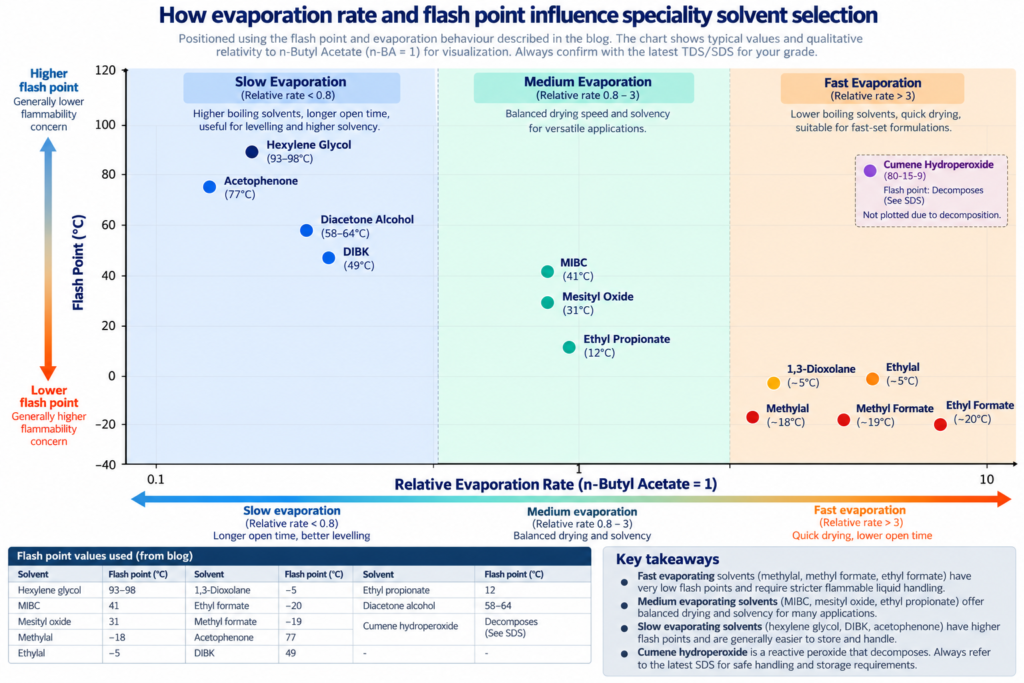
In practice, speciality solvents fall into three working groups. Fast solvents suit applications that need rapid release, short open time or quick drying. Medium solvents balance release against levelling. Slow solvents extend open time, flow and levelling. Methyl formate, ethyl formate and methylal sit at the very fast end of the spectrum, with ethylal and 1,3-dioxolane close behind. Ethyl propionate gives a more moderate drying profile, and DIBK, acetophenone and hexylene glycol sit toward the slow end.
Getting the balance wrong shows up quickly in a film. One that dries too fast can trap defects, blushing, orange-peeling or skinning over before it levels. One that dries too slowly stays tacky and picks up dust. Where the right balance sits depends on application method, film thickness, airflow and plant temperature.
Our detailed guide on solvent evaporation rates explains how to read these numbers and avoid the common traps. For a quick screen of performance against environmental profile, the ACS Green Chemistry Institute’s Solvent Selection Tool is also worth a look [9].
The speciality solvents, family by family
The thirteen products fall into two working families and a small group of specialists. The families share evaporation behaviour and, to a degree, solvency. The specialists are bought for a single function.
Slow and medium solvents: glycols, alcohols and ketones
This family does the heavy lifting in coatings, inks and cleaners. It covers hexylene glycol, diacetone alcohol, DIBK, mesityl oxide and acetophenone. (MIBC is also an alcohol, but it is bought for a different reason and is covered under the specialists below.)
Hexylene glycol (2-methyl-2,4-pentanediol) boils at about 197 °C and mixes freely with water and most organic solvents [10]. Suppliers position it as a coalescing agent in water-borne paints and a coupling agent in hydraulic fluids and cleaners [11]. Its low volatility keeps films open longer, which improves flow.
Chemists make diacetone alcohol from acetone. It is a medium-slow solvent that dissolves cellulose nitrate, many acrylics and several epoxy resins, and under suitable conditions it dehydrates to mesityl oxide. The link matters because mesityl oxide can in turn serve as an intermediate in the production of MIBK and related chemicals.
DIBK is one of the slower ketones here, and producers’ technical sheets describe it as a retarder in high-solids coatings, where it improves leveling [12]. Mesityl oxide is faster and more reactive. It dissolves vinyl, epoxy and cellulose resins, but its unsaturation means compatibility and reaction behaviour should be checked before use.
Acetophenone melts near room temperature, so it can turn solid or partially solid in a cool warehouse. It serves as a resin solvent and as an intermediate in fragrance and pharmaceutical chemistry.
Because these products overlap in function, selection takes care. Our family guide on ketone and alcohol solvents compares them side by side, and the individual guides show which one fits your resin system. Each still needs to be assessed on its own for flammability, regulatory status, purity and storage.
Fast, low-boiling solvents: acetals, formates and an ester
The second family evaporates quickly and can offer useful solvency at relatively low boiling points. It covers methylal, ethylal, 1,3-dioxolane, methyl formate, ethyl formate and ethyl propionate.
Methylal and ethylal are acetals with ether-like solvency characteristics, and they are considered for cleaners, aerosols and solvent replacement. Lambiotte’s acetals cleaning manual describes these uses in detail [13]. 1,3-Dioxolane is a cyclic acetal that dissolves polymers and has drawn significant interest in lithium battery electrolyte research [14]. It can also form peroxides in storage, which is covered under storage and handling below.
Methyl formate and ethyl formate are small, highly volatile formate esters with quite different jobs. Methyl formate serves as a blowing agent for polyurethane foam and as a feedstock for formic acid and formamide [15]. Ethyl formate has been investigated as a fumigant for stored grain and dried fruit [16].
Ethyl propionate occupies the middle ground. It evaporates more slowly than the very fast formates but still dries quickly compared with the slower solvents, which makes it useful in coatings and printing inks that need balanced drying.
All of these products demand respect. Several have very low flash points, so grounding, ignition-source control, ventilation and suitable storage arrangements are essential. The exact classification and handling controls should come from the current SDS and from the regulations that apply at the site and at the destination.
Products with one specialised job
Some products in this manual barely behave like conventional solvents. They earn their place through a single function, and a generic “solvent” mindset fails with them. You need to understand the application, the performance specification and the regulatory path before you place an order.
MIBC is the clearest case. Flotation plants add it in small doses to create a stable froth that carries valuable minerals to the surface. Operators care about consistency, because a shift in frother quality can influence bubble size and recovery, and published plant studies in Minerals Engineering discuss how frother selection affects performance [17].
1,3-Dioxolane works in a different field. Battery researchers use it in ether-based electrolytes, and papers in journals such as ACS Applied Materials & Interfaces examine in-situ polymerised dioxolane electrolytes [14]. Purity and water content become critical here, since small impurity changes can alter electrolyte and cell behaviour.
Ethyl formate acts as a fumigant in certain applications, and USDA Agricultural Research Service work explores its use on stored products [16]. Buyers in this segment need to understand dosing rules and local regulatory approval, not just chemical purity.
Cumene hydroperoxide stands apart again. It is not a conventional solvent. It is an organic peroxide used primarily as a polymerisation initiator and chemical intermediate, and because organic peroxides can undergo hazardous decomposition, it requires dedicated storage, temperature control and compliant handling and transport procedures. The ECHA substance record and supplier safety sheets provide the baseline hazard data [18].
Building a solvent blend
A good solvent system rarely relies on one solvent. Formulators blend fast, medium and slow components so the film behaves well at every stage of drying.
The fast component comes first. It cuts viscosity during application and then leaves quickly, helping the film set. Methylal, methyl formate and ethyl formate sit toward this end, although their flammability can rule them out in some plants. Ethyl propionate is the more moderate option.
A medium solvent then controls the middle of the drying curve, which has a strong influence on flow and leveling. Diacetone alcohol, mesityl oxide and ethyl propionate can fill this role, depending on resin compatibility.
The slow component finishes the job by keeping the film open long enough to level and release trapped air. Hexylene glycol, DIBK and acetophenone fit this slot. Too much of it backfires, though. Residual solvent left in the film may cause softness, odour or slower cure.
Evaporation is only half the picture, because resin compatibility matters just as much. Hansen solubility parameters give a useful starting map, and the HSPiP software and published Hansen studies help narrow the field [19] [20]. Treat the numbers as a guide rather than a guarantee, since real formulations contain pigments, additives and water.
Water-borne systems add another layer. Coalescents such as hexylene glycol help latex particles fuse into a continuous film, and the ACS archive on solvents in water-borne coatings explains the principle [21]. Test freeze-thaw stability, open time and film hardness together rather than in isolation.
The best solvent for one resin may fail in another. Shortlist two or three candidates for each performance requirement and test them side by side, then keep the results, because today’s winner may need replacing when regulations, raw materials or supply change. Our guides on choosing a solvent for your resin and on blending fast, medium and slow speciality solvents both include worked examples.
A framework for choosing a speciality solvent
Selection should not start with the cheapest quotation. Work outward from the job. Set the evaporation and solvency profile the process needs, check that the candidate’s flash point and hazard classification fit your site’s storage and operating controls, and compare price only after the technical requirements are met. The eight questions below follow that order.
- What must the solvent actually do? Dissolve a resin, reduce viscosity, improve flow, control drying, provide open time, act as a coupling solvent, support a cleaning process, create froth, take part in an electrolyte, or serve as a chemical intermediate. A clear functional requirement eliminates many unsuitable candidates straight away.
- Is it compatible with the system, including the water in it? Confirm compatibility with the resin, polymer, binder, pigment, additive package and substrate. Boiling point alone is not enough, because two solvents with similar boiling points can behave very differently once polarity and hydrogen bonding come into play. Check whether the system is water-borne, water-sensitive or completely solvent-based, and consider water miscibility, water tolerance, moisture sensitivity and the effect of water on resin precipitation, phase separation and final performance.
- Does the evaporation profile fit the process temperature? Decide whether the process needs very fast, fast, medium or slow evaporation. A fast solvent may improve initial release but give poor leveling, and a slow one may improve flow while stretching drying time and raising the risk of residual solvent. Review the real temperature range across blending, application, drying, curing, storage and transport, because a solvent that performs well at room temperature may behave very differently in a heated process.
- Can the site handle its flash point, and is the packaging right? Compare the flash point with your plant’s operating temperatures and storage controls, and use the current SDS and the relevant regulatory classification to set handling, storage and transport requirements. Choose drums, IBCs or other packaging according to the product’s properties, its transport classification, the storage period and customer requirements. Reactive and highly flammable materials may need additional controls and packaging specifications.
- Which impurities actually matter? Depending on the product, the critical parameters may include GC purity, water, acidity, colour, residue, inhibitor or stabiliser content, peroxide content or other specified impurities. Do not simply ask for “99% purity” when the real specification is controlled by water, acidity or something else.
Expert perspective
Most complaints we hear about speciality solvents trace back to a mismatch between the grade and the job. Buyers focus on purity and forget water content, acidity or the stabiliser. We always ask for the application first, because it tells us which numbers on the certificate actually matter.
- What does the finished product’s market require? Determine whether the solvent meets the regulatory requirements of the finished product and of the market where it will be sold. Check VOC and HAP considerations, chemical registration, hazard classification, labelling and any restrictions tied to the intended use. The next section looks at these in more detail.
- Does it work in your hands? A datasheet can shortlist candidates, but only formulation testing shows whether a solvent actually performs. Test at laboratory and pilot scale for viscosity, drying, leveling, gloss, hardness, adhesion, stability, odour and any other application-specific properties.
- What does it cost in total, and who is supplying it? Include freight, packaging, handling, storage, losses, batch-rejection risk, rework, lead time and regulatory costs. The lowest product price is not necessarily the lowest total formulation cost. Then qualify the supplier: manufacturing source, traceability, consistency, documentation, sample performance, production capacity and responsiveness. A technically suitable solvent from an unreliable supplier can cost more than a slightly pricier product from a consistent one.
VOC, HAP and the wider regulatory picture
Regulation increasingly shapes solvent choice. Plenty of projects start not with a performance goal but with a restricted ingredient that has to go.
Two terms come up constantly, and they are not interchangeable. A volatile organic compound (VOC) contributes to ground-level ozone, and each jurisdiction keeps its own rules and exemptions. In the United States, the EPA publishes its VOC exemption rules [22]. A hazardous air pollutant (HAP) is a separate legal category under the Clean Air Act, and the EPA keeps its own list [23].
The two systems overlap but do not match. A solvent can have a particular VOC status and still carry other health, safety or environmental hazards, and a solvent can count as a VOC yet fall outside the HAP list. Check the rules that apply to your formulation, process and market rather than assuming one classification answers every regulatory question.
Replacing a restricted solvent
Substitution works best with a structure. Define what the old solvent actually did: dissolve, retard, couple or clean. Shortlist candidates with a similar evaporation rate and solubility profile, then test them on your real formulation. Eastman’s solvent substitution tip sheet outlines the process [24], and the American Coatings Association has published guidance on solvent replacement [25].
Hexylene glycol often appears on substitution shortlists because it is a diol rather than a glycol ether. A draft Indian Standard for hexylene glycol, circulated in 2025, describes it as a potential substitute for glycol ethers [26]. Methylal and ethylal appear on lists for replacing chlorinated and ether solvents.
Document everything. Regulators and customers increasingly ask for evidence that a substitution has not simply moved the problem elsewhere. Rules also keep changing, so build a periodic review of your solvents into the compliance calendar, since a solvent that is acceptable for one application or market may face different requirements in another.
The international layers
No single worldwide chemical regulation applies automatically to every speciality solvent. International compliance is built from several layers, and buyers and formulators should review them together.
Hazard communication comes first. The Globally Harmonized System (GHS), maintained by UNECE, is the international framework behind hazard classification, labels and safety data sheets, but countries and regions implement it through their own laws [27]. Chemical registration and market access sit on top of that. The European Union, for example, operates under REACH, with classification and labelling governed through the CLP framework. REACH registration obligations depend on factors such as the substance, the actor’s role, applicable exemptions and annual tonnage, and ECHA notes that the one-tonne-per-year threshold is an important part of working out those obligations [28] [29].
Product-specific environmental rules form the third layer. VOC, HAP, emissions and solvent-use requirements differ between jurisdictions and industries, and the United States, for instance, maintains specific federal VOC and HAP rules for certain applications and sectors [22] [23]. Destination-specific chemical and product regulation is the fourth. A solvent may satisfy the chemical requirements in one market and still need different classification, labelling, notification, registration or end-use checks in another. Finally, transport and workplace requirements operate alongside chemical legislation, and depending on the product and shipment mode, dangerous-goods, storage, workplace exposure, packaging and emergency-response rules may apply.
The practical approach is straightforward. Identify the destination market and the intended use, work out who carries regulatory responsibility in the supply chain, and verify current requirements before commercial production or shipment. Do not rely on an old SDS, and do not assume that compliance in one country means compliance in another. This manual keeps the international framework at a high level; country-specific import, export, registration and documentation requirements are covered in our dedicated export and import pillar.
Safe storage and handling
Safety guidance for speciality solvents comes down to four habits: know the hazard, control ignition, limit exposure and plan for spills.
Start by knowing the hazard. The NIOSH Pocket Guide to Chemical Hazards lists exposure information and symptoms for many chemicals [30], and the GHS labels on containers carry the classification behind them.
Ignition control matters most for low-flash products such as methylal, ethylal, 1,3-dioxolane and the formates. Bond and ground containers during transfer, use appropriately rated electrical equipment wherever required, keep stock away from heat, sparks, flames and other ignition sources, and make sure ventilation suits the facility and the vapour characteristics of the product.
Limit exposure through closed transfer, local extraction and suitable gloves and eye protection. Hexylene glycol, for example, carries skin and eye irritation concerns [10], so splash protection is sensible even though its volatility is low. Other products, such as mesityl oxide and cumene hydroperoxide, may need stricter controls.
Plan for spills and fire before you need to. Keep suitable absorbent material, appropriate extinguishing media and emergency contacts close to the storage area, and train staff on the specific product, not on chemicals in general.
Two cases need extra attention. Cumene hydroperoxide, as an organic peroxide, must be stored and handled within the supplier’s specified temperature range, container requirements and incompatibilities. Never improvise storage conditions, and never return contaminated or unused material to the original container. Peroxide-forming solvents such as 1,3-dioxolane deserve a labelled opening date and a retest schedule where the supplier or site procedure recommends one. ASTM E299 describes a standard way to test for trace peroxides in organic solvents [31]. A simple log costs almost nothing and can prevent a serious incident.
Above all, treat every speciality solvent as its own case. The habits that suit hexylene glycol do not suit methylal, and the controls that suit ethyl propionate do not suit cumene hydroperoxide. Read the SDS for each product and train your team on the hazards of what you actually stock.
Importing from India: specifications, packaging and terms
India has become a significant source of speciality solvents, and buyers in Europe, the Middle East, Africa and Southeast Asia increasingly purchase from this country. A smooth purchase depends on 3 decisions made early: specification, packaging and commercial terms.
Settle the specification first. Agree on purity by gas chromatography, water by Karl Fischer titration, acidity and colour before you sign [32] [33], and ask which test method the supplier uses for each parameter, since different methods can produce different numbers.
Packaging comes next. Suppliers may ship liquids in steel or plastic drums, intermediate bulk containers (IBCs) or ISO tanks, depending on the product, quantity, destination and applicable regulations. Flammable and reactive products need packaging that meets the relevant dangerous-goods requirements. Our guide on drums, IBCs and ISO tanks explains the trade-offs.
Then the commercial terms. Incoterms 2020, published by the International Chamber of Commerce, define responsibilities for costs, delivery and risk at each stage [34]. FOB, CFR and CIF are common choices for sea freight, but the right rule depends on what the buyer and seller can each handle logistically.
Qualifying the supplier
A cheap / lower than market price quote means little if the product arrives out of specification, and supplier qualification is what protects you from that.
Begin with three documents. The certificate of analysis (COA) reports test results for the specific lot. The technical data sheet (TDS) describes typical properties and uses. The safety data sheet (SDS) follows the recognised sixteen-section format and covers hazards, handling and transport [35] [36]. Read all three before you buy, and compare the COA against your own incoming specification.
Then ask about traceability. Can the supplier link a drum or IBC to a production batch? Do they retain samples? Will they share the manufacturer’s name where appropriate? Find out, too, whether you are dealing with a manufacturer, an authorised distributor or a trader. Good suppliers answer these questions clearly.
Regulatory standing comes next. If you import into the European Union, REACH registration obligations may apply, as outlined in the regulatory section above. Ask for the relevant registration information and verify it through the appropriate ECHA records where applicable.
Finally, test a sample in your own formulation, not just the lab’s standard method, and repeat the test on the first commercial lot. A good sample followed by a poor lot is the classic supplier failure.
Expert perspective
A good buyer asks questions that make us slightly uncomfortable yet crucial from both the buyer’s and supplier’s perspective. Where exactly are the solvents manufactured? Which method measured the water? How do we handle a crisis if the lot fails to cross the benchmark? We respect those questions, because they usually come from buyers who stay with us for years.
From enquiry to delivery
A disciplined workflow removes most technical and commercial surprises. 9 steps cover it.
- Define the requirement. Start with the application, product name, CAS number, required grade, purity, water specification, packaging, annual quantity and destination. Do not request a quotation on the chemical name alone when the application depends on a critical specification.
- Shortlist suppliers. Check availability, manufacturing source, export experience, production capacity and relevant market experience.
- Collect the technical and compliance package. Ask for the current TDS, SDS, specification and a representative COA, plus origin information, regulatory documentation, stabiliser details and dangerous-goods information where relevant. Compare the supplier’s specification with your internal requirement line by line, paying particular attention to the parameters that matter most to your formulation, such as water, acidity, GC purity, colour, inhibitor content or other critical impurities.
- Sample and test. Run the candidate in your actual formulation or process, and record the results instead of relying on a subjective pass or fail.
- Get a commercial quotation. Compare price, packaging, MOQ, payment terms, lead time, Incoterm, freight assumptions and validity period, and judge on total delivered cost rather than product price alone.
- Confirm the first commercial lot before dispatch. Verify the production batch, quantity, packaging, marking and documentation, and where appropriate request the final or pre-dispatch COA against the agreed specification.
- Verify transport documentation. For regulated products, confirm the dangerous-goods classification, packaging, labels and required transport documents before the cargo moves. Sea shipments follow the IMDG Code and air shipments follow IATA regulations [37] [38], and the supplier should provide the relevant documentation and markings. On the Indian side, export clearance runs through customs, with procedures published by the Central Board of Indirect Taxes and Customs, while the Directorate General of Foreign Trade sets the wider policy framework [39] [40]. Your supplier should manage these steps, but you should understand them well enough to ask good questions.
- Inspect on arrival. Check the product against the agreed specification. A sample that passed does not automatically guarantee every commercial lot.
- Review supplier performance. Record quality, documentation accuracy, packaging condition, delivery performance and responsiveness. A supplier that consistently meets specification and documentation requirements is usually worth more than one that simply offered the lowest first quotation.
Buyers who treat speciality solvents as a purchasing exercise tend to meet their surprises at the port. Those who treat each one as a technical, regulatory and logistics project avoid most of them.
Frequently Asked Questions (FAQs)
Are speciality solvents more expensive than commodity solvents?
Usually, though not always. Production volumes can be smaller, and purity or application requirements tighter. A well-chosen speciality solvent can still lower total formulation cost by improving processing, replacing several additives or reducing rejected batches.
Can I swap one speciality solvent for another with a similar boiling point?
Not safely on boiling point alone. Solvency, evaporation profile, water miscibility, polarity, reactivity, odour, flash point and resin compatibility can all differ. Test every substitute in your own formulation.
Is flash point the same as evaporation rate?
No. Evaporation rate describes how quickly a liquid vaporises under defined conditions relative to a reference. Flash point is a flammability-related property measured by a specified test method, and a low value does not tell you how quickly a solvent will leave a coating.
Which speciality solvents suit slow-drying formulations?
Hexylene glycol, DIBK and acetophenone sit toward the slower end of the evaporation spectrum in this manual. The final choice still depends on resin compatibility, water balance, application method and curing conditions.
Which speciality solvents suit fast drying?
Methyl formate, ethyl formate, methylal and ethylal are examples of very fast, low-boiling materials. Their flammability and regulatory characteristics must be assessed before use.
Which speciality solvents are relevant to coatings?
Hexylene glycol, DIBK, acetophenone, diacetone alcohol and ethyl propionate are among the products discussed here for coatings-related applications. The best choice depends on the resin and the drying profile required.
Which speciality solvent is used in mineral flotation?
MIBC is widely used as a flotation frother, where controlling bubble formation and froth behaviour is important.
Which speciality solvent is relevant to battery applications?
1,3-Dioxolane is the main battery-related product covered in this manual. It has been studied in ether-based and polymerised electrolyte systems [14].
How do I choose between a fast, medium and slow solvent?
Start with the process requirement. Fast solvents favour quick release, medium solvents help balance drying and flow, and slow solvents give longer open time and can improve leveling. Most complex formulations need a combination rather than one solvent alone.
What documents should come with a speciality solvent?
Ask for a COA, TDS and SDS with every commercial product. Depending on the product and the transaction, you may also need dangerous-goods documents, regulatory information, origin documentation or other customer-specific compliance records.
How should I compare two suppliers offering the same solvent?
Compare the complete specification, manufacturing source, consistency, COA quality, sample performance, packaging, lead time, documentation, regulatory support and total delivered cost. Do not decide on price alone.
Do speciality solvents expire?
Shelf life varies with the chemical, grade, stabiliser system, packaging and storage conditions. Use the shelf-life information supplied by the manufacturer and follow any special storage or retesting requirements. Peroxide-forming materials need particular attention to storage time and testing.
Where to go next
This manual introduces the whole subject, and the rest of the series takes each product and sourcing topic in depth. Coatings teams should start with hexylene glycol, diacetone alcohol, DIBK and ethyl propionate. For cleaning or aerosols, begin with methylal and ethylal. Battery researchers will want 1,3-dioxolane, and mining teams the MIBC series. Importers should look at the sourcing guides on packaging, dangerous goods, COA review and REACH compliance.
Every product guide follows the same sequence: what the solvent is, where it performs, how it compares with alternatives, how to handle it and how to buy it. That consistency means you can move from one product to the next without relearning the format.
Source your speciality solvents from NewZeal Chemicals
NewZeal Chemicals supplies speciality solvents and related speciality chemicals to formulators, manufacturers and importers worldwide. The range includes hexylene glycol, MIBC, mesityl oxide, methylal, ethylal, 1,3-dioxolane, ethyl formate, methyl formate, acetophenone, DIBK, ethyl propionate, diacetone alcohol and cumene hydroperoxide.
We provide specifications, packaging options and export documentation matched to the requirements of the relevant market and application. To have our team evaluate the appropriate grade and commercial specification, send your product requirement, application, quantity, packaging and destination through the enquiry form below.
References
1. Ullmann’s Encyclopedia of Industrial Chemistry (Wiley-VCH). https://onlinelibrary.wiley.com/book/10.1002/14356007
2. Kirk-Othmer Encyclopedia of Chemical Technology (Wiley). https://onlinelibrary.wiley.com/book/10.1002/0471238961
3. PubChem – Hexylene Glycol, CID 7870. https://pubchem.ncbi.nlm.nih.gov/compound/7870
4. PubChem – 4-Methyl-2-Pentanol (MIBC). https://pubchem.ncbi.nlm.nih.gov/compound/4-Methyl-2-Pentanol
5. PubChem – Mesityl Oxide. https://pubchem.ncbi.nlm.nih.gov/compound/Mesityl-oxide
6. ASTM D3539 – Relative Evaporation Rate. https://www.astm.org/d3539-11r19.html
7. ASTM D56 – Flash Point by Tag Closed Cup Tester. https://www.astm.org/d0056-21a.html
8. ASTM D93 – Flash Point by Pensky-Martens Closed Cup Tester. https://www.astm.org/d0093-20.html
9. ACS Green Chemistry Institute – Solvent Selection Tool. https://www.acs.org/greenchemistry/industry-resources/solvent-selection-tool.html
10. TCI Chemicals – 2-Methylpentane-2,4-diol (hexylene glycol) product page. https://www.tcichemicals.com/IL/en/p/M0384
11. Solvay – Hexylene Glycol product page. https://www.solvay.com/en/product/hexylene-glycol
12. Ark-Chem DIBK Retarder Data. https://ark-chem.co.jp/download/7222/DIBK%20TDS.pdf
13. Lambiotte Acetals Cleaning Manual. https://discover.univarsolutions.com/assets/files/mexico/Brochure-Acetals-in-Cleaning-Lambiotte-Cie.pdf
14. ACS Applied Materials & Interfaces – In-situ-polymerized DOL electrolyte. https://pubs.acs.org/doi/10.1021/acsami.3c04234
15. ACS – Methyl Formate Blowing Agent / Rigid Polyurethane Foams. https://pubs.acs.org/doi/10.1021/acs.iecr.5b04711
16. USDA Agricultural Research Service – Ethyl Formate Research. https://www.ars.usda.gov/research/publications/publication/?seqNo115=426786
17. Minerals Engineering – Frother analysis: Some plant experiences. https://www.sciencedirect.com/science/article/abs/pii/S0892687507002026
18. Cumene Hydroperoxide – ECHA Substance Information. https://echa.europa.eu/substance-information/-/substanceinfo/100.001.141
19. Hansen Solubility Parameters – HSPiP. https://www.hansen-solubility.com/
20. ACS – Greener Solvent Selection in Hansen Space. https://pubs.acs.org/doi/10.1021/ie402410w
21. ACS – Solvents in Water-Borne Coatings. https://pubs.acs.org/doi/10.1021/i360063a016
22. EPA: Complete list of VOC exemption rules. https://www.epa.gov/ground-level-ozone-pollution/complete-list-voc-exemption-rules
23. US EPA – Hazardous Air Pollutants (HAPs). https://www.epa.gov/haps/initial-list-hazardous-air-pollutants-modifications
24. Eastman Solvent Substitution Tip Sheet. https://www.eastman.com/content/dam/eastman/corporate/en/literature/t/tt87.pdf
25. American Coatings Association – Solvent Replacement. https://www.paint.org/coatingstech-magazine/articles/solvent-replacement/
26. Bureau of Indian Standards – Draft Indian Standard, Hexylene Glycol Specification (PCD 09, July 2025). https://www.services.bis.gov.in/tmp/WCPCD5127971_25072025_2.pdf
27. UNECE GHS Purple Book, Rev. 10. https://unece.org/transport/standards/transport/dangerous-goods/ghs-rev10-2023
28. ECHA – One-tonne registration threshold. https://echa.europa.eu/support/registration/your-registration-obligations/do-i-reach-the-one-tonne-a-year-threshold
29. ECHA – REACH Registration. https://echa.europa.eu/regulations/reach/registration
30. CDC/NIOSH – Pocket Guide to Chemical Hazards. https://www.cdc.gov/niosh/npg/default.html
31. ASTM E299 – Trace Amounts of Peroxides in Organic Solvents. https://www.astm.org/e0299-17a.html
32. ASTM E203 – Water by Karl Fischer Titration. https://www.astm.org/e0203-16.html
33. ASTM D1613 – Acidity in Volatile Solvents and Chemical Intermediates. https://www.astm.org/d1613-17.html
34. ICC Incoterms 2020 official rulebook. https://store.iccwbo.org/
35. ECHA – Safety Data Sheets. https://echa.europa.eu/safety-data-sheets
36. ISO 11014:2009 – Safety Data Sheets. https://www.iso.org/standard/44690.html
37. IMO – International Maritime Dangerous Goods (IMDG) Code. https://www.imo.org/en/publications/pages/imdg-code.aspx
38. IATA Dangerous Goods Regulations overview. https://www.iata.org/en/publications/dgr/
39. CBIC India – Central Board of Indirect Taxes and Customs. https://www.cbic.gov.in/
40. India DGFT – Foreign Trade Policy 2023. https://content.dgft.gov.in/Website/dgftprod/61d61bc2-272e-4880-b96c-c8f685a3b244/Foreign%20Trade%20Policy%202023.pdf